EN
EN  AR
AR 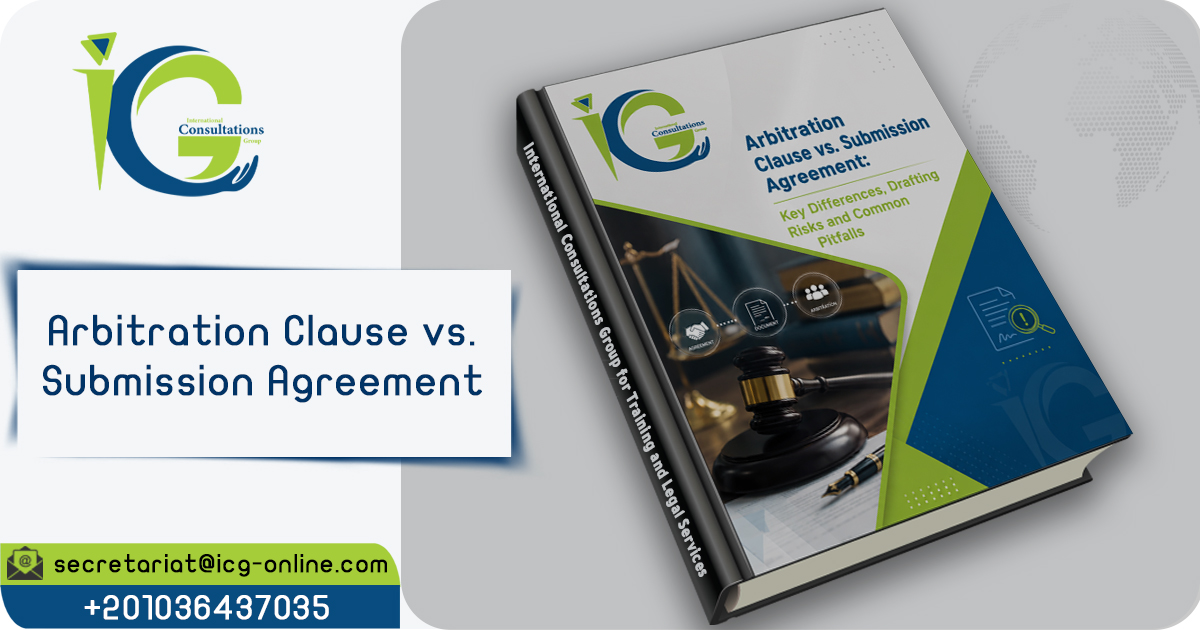
Arbitration is one of the most widely used mechanisms for the resolution of commercial and investment disputes. However, the effectiveness of arbitration largely depends on the validity and precision of the arbitration agreement. In practice, the parties may agree to arbitration either through an arbitration clause incorporated into their contract or through a separate submission agreement concluded after a dispute has arisen.
-
Arbitration Clause and Submission Agreement: What Is the Difference?
An arbitration clause is an agreement by which the parties agree, in advance, to refer to arbitration disputes that may arise in the future in connection with their contractual relationship. It is therefore normally incorporated into the underlying contract and concerns potential or future disputes.
By contrast, a submission agreement—also referred to in some legal systems as a compromis—is concluded after a dispute has arisen. Through the submission agreement, the parties agree to submit an existing and identified dispute to arbitration.
Accordingly, the essential distinction is that an arbitration clause concerns future or potential disputes, whereas a submission agreement concerns an existing dispute. Because the dispute already exists when a submission agreement is concluded, it generally requires greater specificity regarding the dispute submitted to arbitration and the scope of the arbitral tribunal’s mandate.
-
Why Is Careful Drafting of an Arbitration Clause Important?
An arbitration clause should not merely express the parties’ intention to arbitrate. It should establish a clear and operable arbitration agreement capable of being effectively invoked when a dispute arises.
Poorly drafted arbitration clauses may result in uncertainty concerning the existence, validity, scope or operation of the arbitration agreement. In some cases, such uncertainty may lead to preliminary disputes concerning the jurisdiction of the arbitral tribunal, delaying the resolution of the underlying dispute.
Common drafting issues include:
- Failure to clearly define the scope of disputes covered by the arbitration agreement;
- Uncertainty regarding the constitution of the arbitral tribunal and the appointment of arbitrators;
- Failure to establish an appropriate mechanism for appointing arbitrators in multi-party arbitrations;
- Uncertainty regarding the seat of arbitration;
- Failure to specify, where appropriate, the language of the arbitration and the law applicable to the dispute;
- Incorrect or ambiguous identification of the arbitral institution or applicable arbitration rules; and
- Unclear incorporation by reference of arbitration provisions contained in another document.
-
Pathological Arbitration Clauses
A poorly drafted arbitration clause is sometimes described as a “pathological arbitration clause”. This term generally refers to an arbitration clause containing ambiguities, inconsistencies, omissions or other drafting defects that may create difficulties in its interpretation or enforcement.
A pathological clause does not necessarily mean that the arbitration agreement is automatically invalid. However, deficiencies in drafting may create disputes over the existence, validity, scope or enforceability of the arbitration agreement and may complicate the commencement or conduct of the arbitration.
For this reason, the arbitration clause should be drafted with particular attention to the parties’ intended jurisdictional scope, the applicable procedural framework and the mechanism for constituting the arbitral tribunal.
-
Particular Risks in Multi-Party Arbitration
Special care is required when drafting arbitration clauses for contracts involving multiple parties.
A clause providing that an arbitral tribunal shall consist of three arbitrators, for example, may be insufficient if it does not clearly establish how the parties are to exercise their rights to nominate arbitrators where there are multiple claimants or multiple respondents.
Ambiguous drafting may create disputes as to whether each individual party is entitled to nominate an arbitrator or whether the parties on each side of the dispute must act jointly.
The arbitration agreement should therefore establish a clear and workable mechanism for constituting the arbitral tribunal, particularly where multiple claimants, respondents or contracting parties may become involved in the same dispute.
-
Incorporation by Reference and Contractual Annexes
Another important drafting issue arises where the arbitration provision is contained in annexes, schedules, standard terms or other documents incorporated into the contract.
A general reference to another document may not, in every case, be sufficient to establish the parties’ agreement to the arbitration clause contained in that document. The incorporation should therefore be sufficiently clear to demonstrate that the parties intended to adopt the arbitration provision.
Particular caution is required where an annex or schedule contains an arbitration clause but has not been signed by the parties. Depending on the applicable law and the wording of the underlying contract, questions may arise as to whether the arbitration agreement was effectively incorporated and agreed upon.
-
Key Takeaway
An arbitration agreement is much more than a standard contractual provision. Its drafting determines the framework within which the parties may be required to resolve their disputes.
A well-drafted arbitration clause should therefore clearly address the essential elements of the parties’ agreement, including the scope of arbitration, constitution of the arbitral tribunal, applicable arbitration rules, seat of arbitration and other relevant procedural matters.
Where appropriate, parties may also consider using model arbitration clauses recommended by established arbitral institutions, while adapting them to the specific nature of the transaction, the parties and the potential disputes.
Careful drafting at the contracting stage can significantly reduce the risk of jurisdictional and procedural disputes when arbitration becomes necessary.
At International Consultations Group (ICG), we provide professional legal and contract drafting services designed to help businesses and organizations structure their contractual relationships clearly and reduce potential legal and commercial risks.
Our team can assist with the drafting, review and analysis of commercial contracts and arbitration agreements, including arbitration clauses, dispute resolution provisions and other contractual mechanisms relevant to domestic and cross-border transactions.
Contact Us
If you require tailored legal advice or assistance with contract drafting, contract review, arbitration agreements or dispute resolution provisions, our team is ready to assist.
International Consultations Group (ICG)
Email: Secretariat@icg-online.com
Phone: +20 103 643 7035
Contact us today to discuss how we can assist you in drafting and reviewing your contractual arrangements and managing potential legal risks.
الإصدار العربي